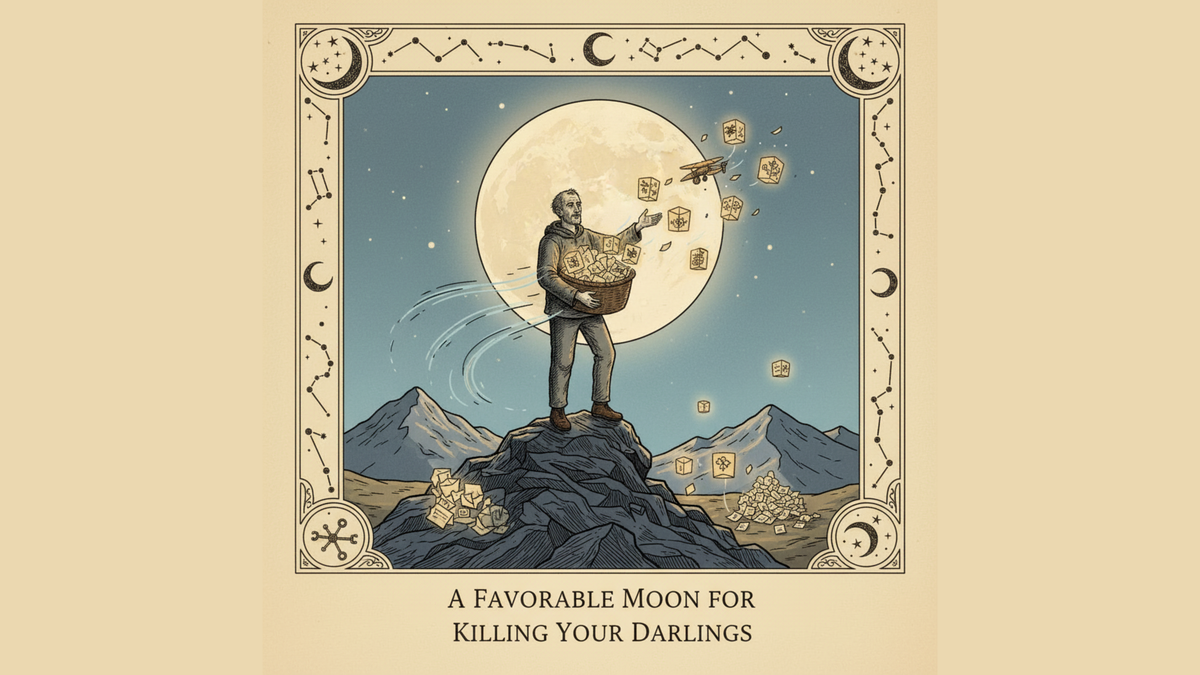
A Favorable Moon for Killing Your Darlings
The best teams aren’t the ones with the most ideas. They’re the ones brave enough to release the right ones at the right time.

There’s a moment in every campaign when you already know.
The slide everyone likes.
The line that got laughs in the brainstorm.
The concept that feels clever enough to survive scrutiny.
That’s the darling.
Darlings are dangerous not because they’re bad, but because they’re beloved. They accumulate defenders. They earn grace they haven’t earned in performance. They linger past the point where evidence turns from ambiguous to inconvenient.
This is where the moon comes in.
Not literally—though blaming the cosmos has its uses. Favorable moons are simply moments when distance appears. When enough time has passed that you can look at the work without remembering how hard it was to make.
Distance is mercy. It lets you see clearly.
Killing a darling isn’t an act of brutality. It’s an act of respect—for the goal, for the audience, for the rest of the work that now has room to breathe. What you remove stops draining attention. What remains gets sharper by contrast.
The trap is timing.
Teams try to kill darlings too early, when ideas are still fragile and need protection. Or too late, when the darling has been operationalized, resourced, and emotionally insured by too many stakeholders to touch.
The favorable moon sits between those extremes.
It’s when:
• The idea has been tested enough to know its limits
• The outcome can be named without narrative gymnastics
• The cost of continuation is higher than the cost of replacement
At that point, sentiment is no longer insight.
The most common defense of a darling sounds reasonable:
“Let’s give it a little more time.”
Time is rarely the missing ingredient. Clarity is.
If the idea were working, it wouldn’t need a lunar cycle to prove it. Momentum announces itself. When performance whispers, it’s usually asking to be let go.
Experienced operators ritualize this moment. They schedule reviews designed not to save ideas, but to interrogate them. They ask questions that feel disloyal and answer them without theatrics.
What problem is this still solving?
Who would notice if it disappeared?
What would we build instead if we weren’t protecting this?
When the answers come easily, the decision already exists.
The irony is that killing a darling often unlocks more creativity, not less. Constraint returns. Space opens. The team remembers it’s allowed to move forward instead of sideways.
So yes—wait for a favorable moon.
Wait for distance.
Wait for evidence.
Wait for the moment when letting go feels sad but obvious.
Then act cleanly. No apology tour. No half-measures. No zombie afterlife in a backup folder.
The best teams aren’t the ones with the most ideas.
They’re the ones brave enough to release the right ones at the right time.
Some nights are made for planting.
Some nights are made for harvest.
And some—quiet, necessary, clarifying nights—are made for killing your darlings so the rest of the work can finally live.