Acts of God: What To Do When Platforms Break
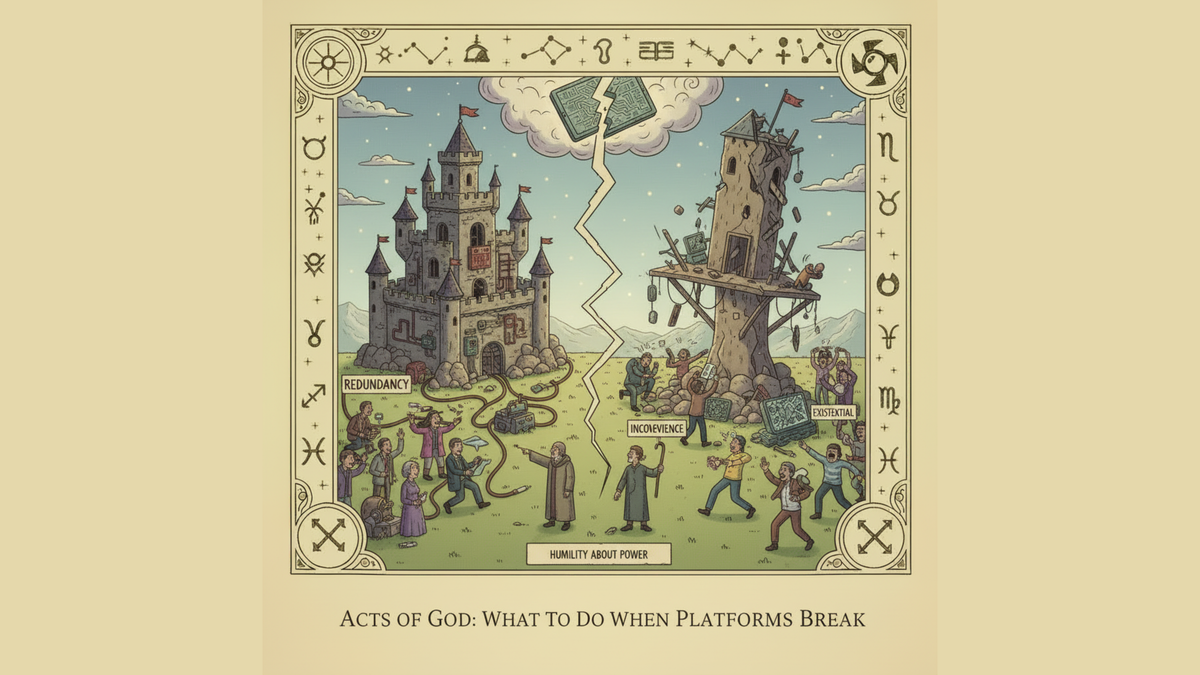
Teams that built redundancy treat outages as inconvenience. Teams that built dependency treat them as existential threats. The difference isn’t talent or tooling—it’s humility about where power actually sits.

Every platform eventually breaks.
Not metaphorically. Literally.
APIs stall. Dashboards freeze. Accounts get flagged without warning. Policies change between breakfast and lunch. The help center updates after the damage is done.
When it happens, the language gets strange.
“It’s a known issue.”
“We’re investigating.”
“This is an edge case.”
That phrase—act of God—floats in from the legal world, meant to describe events so uncontrollable no one can reasonably be held responsible. Storms. Earthquakes. Floods.
Platforms love this framing. It absolves them and paralyzes everyone else.
But here’s the uncomfortable truth:
Platform failure is not an act of God. It’s a structural certainty.
These systems are too complex, too centralized, and too financially incentivized to behave otherwise. They optimize for scale, not resilience. For revenue, not your quarter. When they break, it’s not random—it’s deferred risk finally surfacing.
The mistake most teams make is treating platform outages as anomalies instead of signals.
They scramble. They wait. They reassure stakeholders that things will “normalize.” They assume the platform will fix itself before the damage compounds.
Sometimes it does. Sometimes it doesn’t. Either way, time is doing work while everyone pretends it isn’t.
The right response starts before the break.
Experienced operators assume fragility. They build plans that expect interruption, not perfection. They ask questions that feel pessimistic in good times and lifesaving in bad ones.
What happens if this channel goes dark for a week?
Which metrics would lie to us first?
What decisions become impossible without this data?
If the honest answers are “everything” and “all of them,” you’re not operating—you’re renting stability from someone who doesn’t owe it to you.
When the break actually hits, clarity matters more than speed.
First: stop pretending.
Name what’s broken, what’s unknown, and what decisions are temporarily suspended. Silence creates more panic than bad news.
Second: protect capital.
Pause spend that depends on compromised systems. Bad data is worse than no data. Spending through blindness is how losses masquerade as patience.
Third: shift from optimization to preservation.
This is not the moment to get clever. It’s the moment to keep damage contained. Reduce complexity. Cut dependencies. Buy time.
The hardest move is the most counterintuitive one: accept that some outcomes are unrecoverable.
Missed attribution. Lost momentum. Broken learning cycles. Trying to “make it up” after a platform failure often leads to worse decisions than taking the loss cleanly and resetting.
Acts of God reveal posture.
Teams that built redundancy treat outages as inconvenience. Teams that built dependency treat them as existential threats. The difference isn’t talent or tooling—it’s humility about where power actually sits.
Platforms will continue to break. More often, not less.
They are not malicious. They are indifferent.
The work, then, is not to demand reliability from systems that can’t promise it—but to design strategies that don’t collapse when the ground shifts.
Faith belongs in theology.
Resilience belongs in operations.
When the platform breaks, the question isn’t “why did this happen?”
It’s “did we build as if it always would?”
That answer tells you everything you need to know about what to fix next.