
Retail Media: New River or Floodplain?
Most retail media networks were not built to serve advertisers. They were built to monetize existing traffic as quickly as possible.

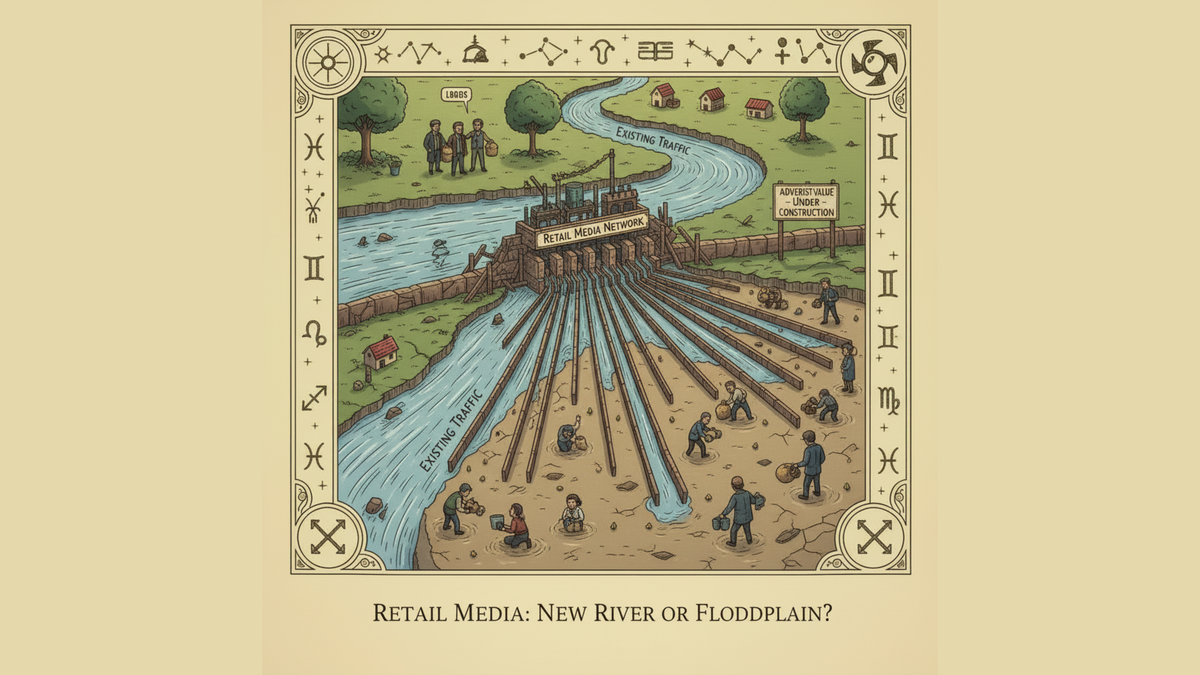
Retail media is being sold as inevitability.
First-party data. Closed-loop measurement. Proximity to purchase. A way to escape the open-web auction without sacrificing scale. The pitch practically writes itself.
And to be fair—there is a real river here.
Retailers sit closest to intent. They see behavior others infer. When executed cleanly, retail media can shorten feedback loops and expose truths brand lift studies never quite catch.
That’s the upside. Now the floodplain.
Most retail media networks were not built to serve advertisers. They were built to monetize existing traffic as quickly as possible. Ad products bolted onto commerce stacks, measurement defined by what’s easiest to report, and incentives that quietly favor the retailer’s margin over the advertiser’s outcome.
The result is a landscape where performance looks strong right up until you ask the wrong question.
Incrementality is the first casualty.
Retail media excels at harvesting demand that already exists. Search-adjacent placements, sponsored listings, on-site display—these are powerful at capturing shoppers who were coming anyway. That doesn’t make them useless. It makes them situational.
The danger is mistaking capture for creation.
As budgets flow in, the same gravity appears as everywhere else. More advertisers, limited inventory, rising costs. What started as efficient access becomes another auction—just one with better branding and fewer external benchmarks.
Measurement doesn’t save you here. It obscures you.
Closed-loop reporting feels authoritative because it’s self-contained. But when the same entity sells the media, defines the conversion, and reports the outcome, skepticism isn’t cynicism—it’s table stakes.
Smart operators test retail media the way they’d test a new river: cautiously, upstream, with a clear exit.
They isolate spend. They look for lift that survives budget removal. They compare against true control regions, not internal baselines that drift with promotions and pricing changes. They accept that some channels are good at defense, not growth.
The tell that you’re in a floodplain is subtle.
Spend increases without proportionate volume gains. Reporting stays positive while margins thin. Teams start saying “it’s table stakes” instead of “it’s working.”
That’s when optionality disappears.
Retail media isn’t the future of marketing. It’s a feature of the present—useful, powerful, and easy to misuse. Treated as infrastructure, it will quietly tax you forever. Treated as a tactic, it can still move real numbers.
The river is real.
So is the flood.
The difference comes down to whether you’re fishing—or building a house where the water rises every spring and wondering why the floors won’t stay dry.