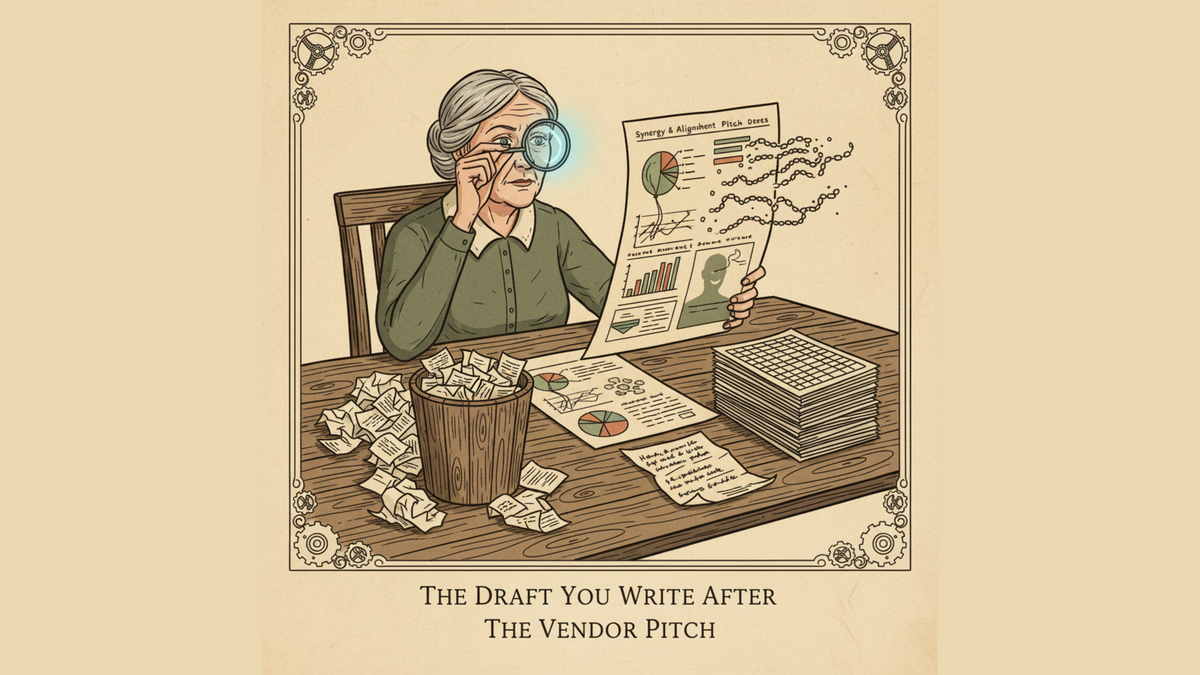
The Draft You Write After The Vendor Pitch
Each unsent version sharpens your internal filter. Over time, patterns emerge. The same promises dressed differently. The same math that only works in slides. The same dependency on “alignment” where ownership should be.

You close the Zoom.
Everyone says polite things.
Cameras go dark. Slack lights up like a switchboard.
This is the moment that never makes it into the deck.
The pitch itself was competent. Too competent. Sharp slides, familiar logos, a confident walk through a playbook you’ve seen three times this quarter under different fonts. They promised partnership. They promised lift. They promised they’d “meet you where you are,” which is consultant for we will invoice you either way.
Now comes the draft you don’t send.
It starts honest.
“Thank you for the time. We see the effort. We recognize the craft. We also recognize that this is not meaningfully different from the last three versions of this story we were told.”
But you soften it. You always do. You delete the sentence about margins. You remove the line about incentives being misaligned. You erase the part where you explain, plainly, that the model only works if conditions are perfect—and conditions are never perfect.
Instead, you write:
“This isn’t the right fit for us at this time.”
What you mean is something closer to this:
This pitch solves your utilization problem, not our business problem.
The risk sits entirely on our balance sheet.
The upside is abstract.
The downside is very real.
You’re not offended. You’re tired.
Tired of pretending novelty is strategy.
Tired of roadmaps that start after onboarding.
Tired of pilots that never quite land but somehow keep billing.
Here’s the quiet truth this draft carries:
Saying no is not a failure of imagination. It’s evidence of one.
Experienced operators develop a nose for friction. They can feel when a proposal will add meetings instead of outcomes, dashboards instead of decisions, activity instead of progress. That instinct isn’t cynicism. It’s scar tissue doing its job.
So you send the short version. You thank them. You wish them luck. You mean it.
And then you save the real draft.
Not to be cruel—but to remember.
Because one day, when the right pitch arrives, you’ll feel the difference immediately. Fewer promises. More constraints. Clear ownership. Real tradeoffs. A plan that assumes things will go wrong and still works anyway.
That’s the one you say yes to.
The rest?
They get the polite email—and a quiet place in the folder of drafts that taught you how to choose better.
There’s a reason these drafts pile up.
They’re not rejections. They’re calibration tools.
Each unsent version sharpens your internal filter. Over time, patterns emerge. The same promises dressed differently. The same math that only works in slides. The same dependency on “alignment” where ownership should be.
Eventually, you stop needing the draft at all.
You hear the pitch and you already know:
• Who carries the risk
• Where the incentives break
• How long it will take before the relationship turns managerial instead of operational
That’s when the real shift happens. You stop being impressed by confidence. You start looking for friction placed intentionally—constraints that protect you, not them.
The best vendors don’t sell inevitability. They sell limits.
They tell you what they won’t do.
They name the conditions where this fails.
They put skin in places lawyers usually avoid.
Those are short meetings. Those are easy yeses.
Until then, you’ll keep writing these drafts. Shorter each time. Colder. Clearer. Less angry, more precise.
Not because you’re bitter.
Because you’ve learned the difference between motion and movement.
And that’s the real function of the unsent email:
It trains you to recognize substance before you pay for the lesson.