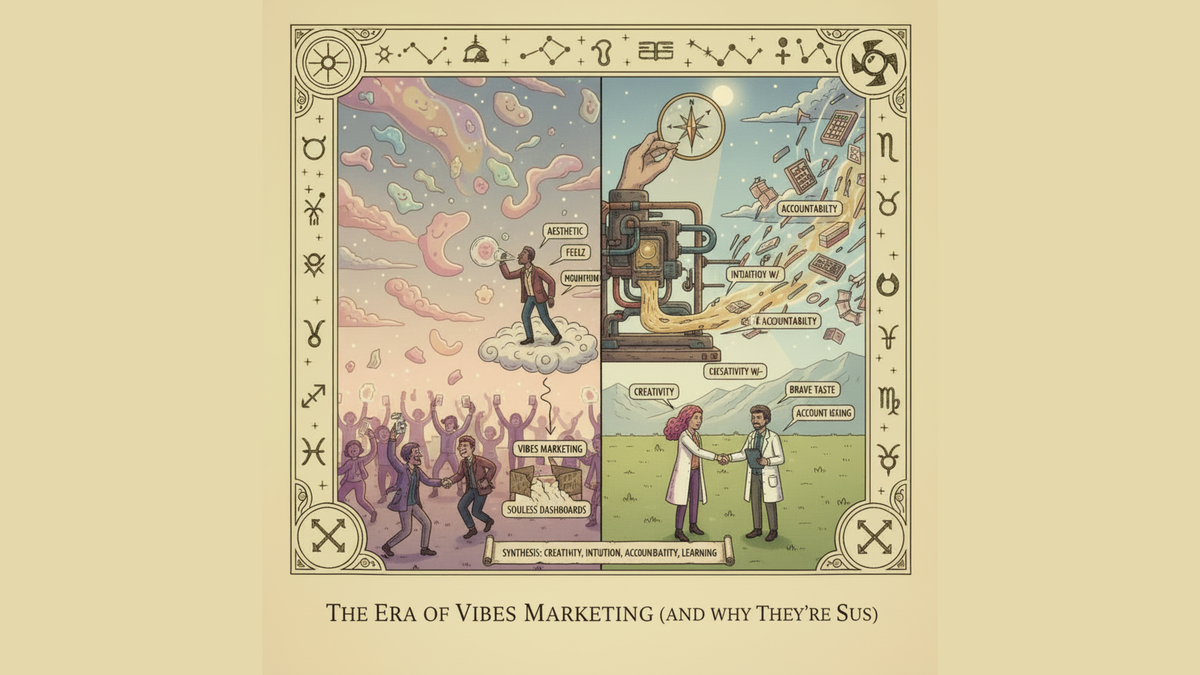
The Era of Vibes Marketing (and Why They’re Sus)
What comes next isn’t a return to soulless dashboards or optimization theater. It’s a synthesis: creativity with consequences, intuition with accountability, taste that’s brave enough to be wrong and disciplined enough to learn.

Vibes marketing had a hell of a run.
It promised intuition over instrumentation. Taste over testing. Culture over spreadsheets. In a moment when data felt weaponized and dashboards felt joyless, vibes offered relief. Finally—permission to feel again.
That permission came with a bill.
Vibes marketing works best in small rooms, tight feedback loops, and short time horizons. Founder-led brands. Early audiences. Channels where the cost of being wrong is survivable and the upside of being early is asymmetric. In those conditions, instinct isn’t reckless—it’s efficient.
The problem is what happened next.
Vibes escaped their habitat.
What started as a corrective to over-optimization became a substitute for accountability. “It feels right” quietly replaced “it works.” Strategy turned into aesthetic alignment. Disagreement became a taste issue instead of a business one.
That’s when things got weird.
Vibes are not falsifiable. You can’t disprove a feeling without being accused of not “getting it.” Metrics that contradicted the vibe were labeled lagging, colonial, or missing the point. Success was redefined as resonance, and resonance was defined by whoever held the loudest microphone.
This is how organizations lose their grip on reality without noticing.
The irony is that vibes marketing didn’t reject data—it selectively adopted it. Engagement screenshots were celebrated. Vanity metrics were rebranded as community signals. Anything inconvenient was dismissed as too “traditional” to matter.
The vibe always won. Until it didn’t.
At scale, vibes collapse under their own ambiguity. Teams stop making decisions; they start performing alignment. Creative becomes untouchable. Media spend drifts. When results soften, no one can diagnose why, because nothing was ever grounded enough to interrogate.
Vibes also age poorly.
What feels fresh today calcifies into sameness tomorrow. Without measurement, there’s no mechanism for evolution—only repetition with better language. Brands that once felt alive start sounding like parody accounts of themselves.
This is usually where the reckoning happens.
Budgets tighten. Leadership asks harder questions. Suddenly, vibes are expected to explain themselves in a language they never learned to speak. The same instinct that was celebrated as visionary is recast as unserious.
That whiplash isn’t fair—but it is predictable.
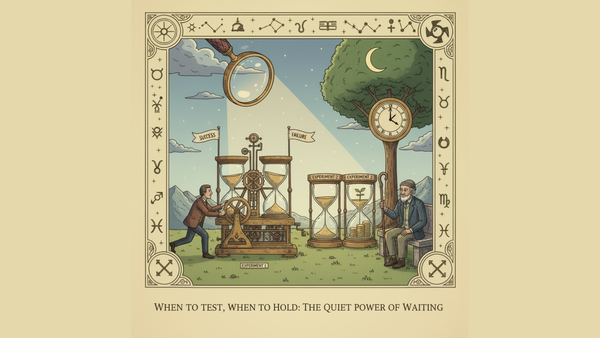
The real failure wasn’t intuition. It was treating intuition as a replacement for evidence instead of a hypothesis generator. Vibes are excellent at suggesting what to try. They are terrible at deciding what to keep.
Healthy marketing cultures know the difference.
They let instincts surface ideas, then submit those ideas to reality. They allow taste to guide exploration, not dictate outcomes. They understand that feelings are inputs—not verdicts.
Vibes are useful at the edge.
Data is necessary at the core.
When the two are in conversation, work gets sharper. When vibes are put in charge, organizations drift. Not dramatically. Quietly. Expensively.
The era of vibes marketing wasn’t a scam. It was a correction that overstayed its welcome.
What comes next isn’t a return to soulless dashboards or optimization theater. It’s a synthesis: creativity with consequences, intuition with accountability, taste that’s brave enough to be wrong and disciplined enough to learn.
Vibes can open the door.
They just shouldn’t be the ones running the house.