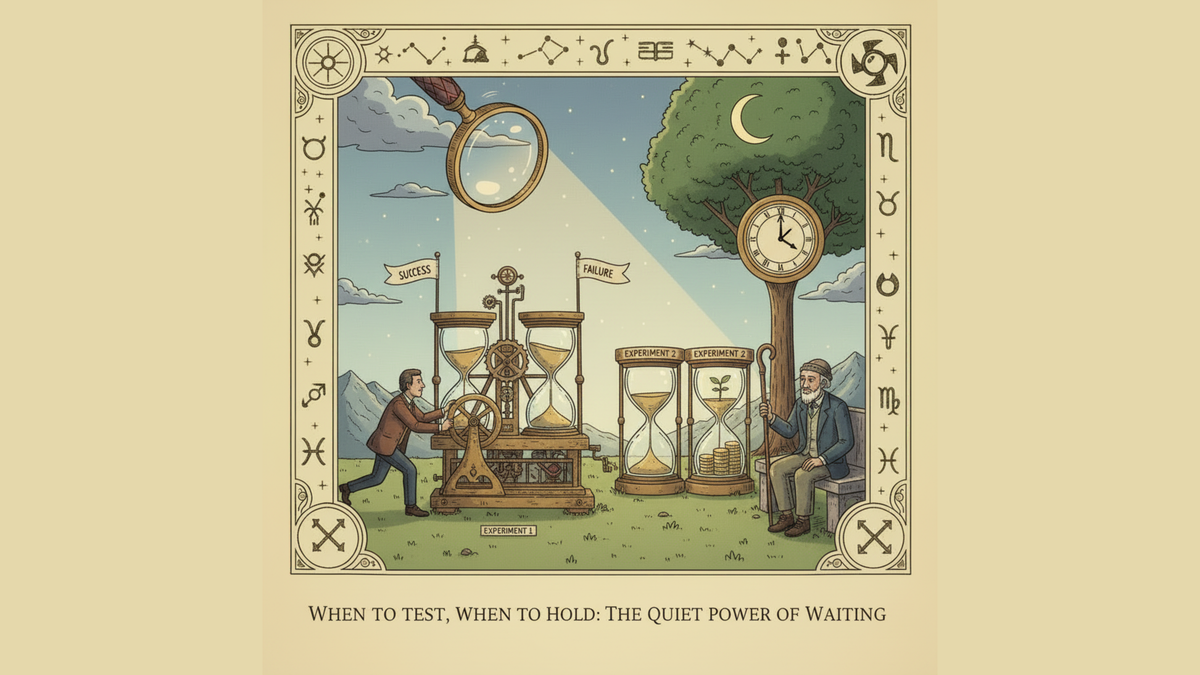
When to Test, When to Hold: The Quiet Power of Waiting
Run the same experiment two weeks apart and you can get opposite conclusions, both technically “correct” and strategically useless.

Most marketing advice assumes action is always better than stillness.
Test more. Launch faster. Ship something—anything—before someone else does.
That instinct is understandable. It’s also expensive.
Testing is not a virtue on its own. It’s a tool. And like any tool, used at the wrong time, it damages more than it builds.
The first thing experienced operators learn—usually the hard way—is that timing determines whether a test produces insight or noise. Run the same experiment two weeks apart and you can get opposite conclusions, both technically “correct” and strategically useless.
Waiting is not indecision. It’s information gathering without burning capital.
There are seasons where testing compounds and seasons where it lies.
Early-cycle markets, fresh creative, new inventory, real distribution change—these are moments where small tests teach you something durable. The system is still elastic. Signal travels cleanly. Learnings stack.
Late-cycle markets behave differently. Audiences are saturated. Auctions are crowded. Platforms are quietly tweaking knobs. In these moments, testing tends to optimize around decay instead of revealing opportunity. You get local maxima. Marginal gains that feel productive but don’t survive scale.
This is where holding becomes the smarter move.
Holding looks passive from the outside. Inside, it’s active restraint. You watch volatility. You track cost curves. You let competitors pay tuition for the same lesson you’re about to learn for free.
The hardest tests to cancel are the ones that feel responsible.
Incremental tweaks. Safe variations. Sensible hypotheses.
But safety is not the same as value.
If a test cannot meaningfully change a decision—budget, channel mix, creative direction—it’s not a test. It’s busywork with charts.
Waiting creates leverage because it preserves optionality. Capital unspent is future freedom. Attention unfragmented is strategic clarity. When conditions shift—and they always do—you’re positioned to move with intent instead of urgency.
There’s a tell, if you’re listening for it.
When teams start arguing about confidence intervals instead of outcomes, it’s time to hold. When results need excessive explanation to justify action, it’s time to pause. When every test “kind of works,” nothing actually does.
The quiet power of waiting is that it sharpens your threshold for action. You stop asking “can we test this?” and start asking “what would have to be true for this to matter?”
That question filters more waste than any experimentation framework ever will.
The best operators don’t test constantly.
They test decisively.
They wait until the environment can reward insight, then move quickly and without apology. Everyone else confuses motion for momentum and wonders why the numbers feel thin.
Waiting isn’t fear.
It’s respect for timing.
And timing, more than creativity or tooling, is what separates durable wins from expensive lessons.